This article may contain affiliate links. If you buy through them, Growing Up at Home may earn a small commission at no extra cost to you. Learn more.
I want to tell you about the desk. It was a good desk. Real wood, the right height, a little hutch on top for pencils and index cards. I set it up in the corner of the living room the summer before third grade started, feeling very proud of myself, like I had solved homework before homework had even become a problem.
My daughter used it exactly twice. Both times were for me, not for her, because I asked her to sit there while I took a picture to send to my mother.
Where the homework actually happens
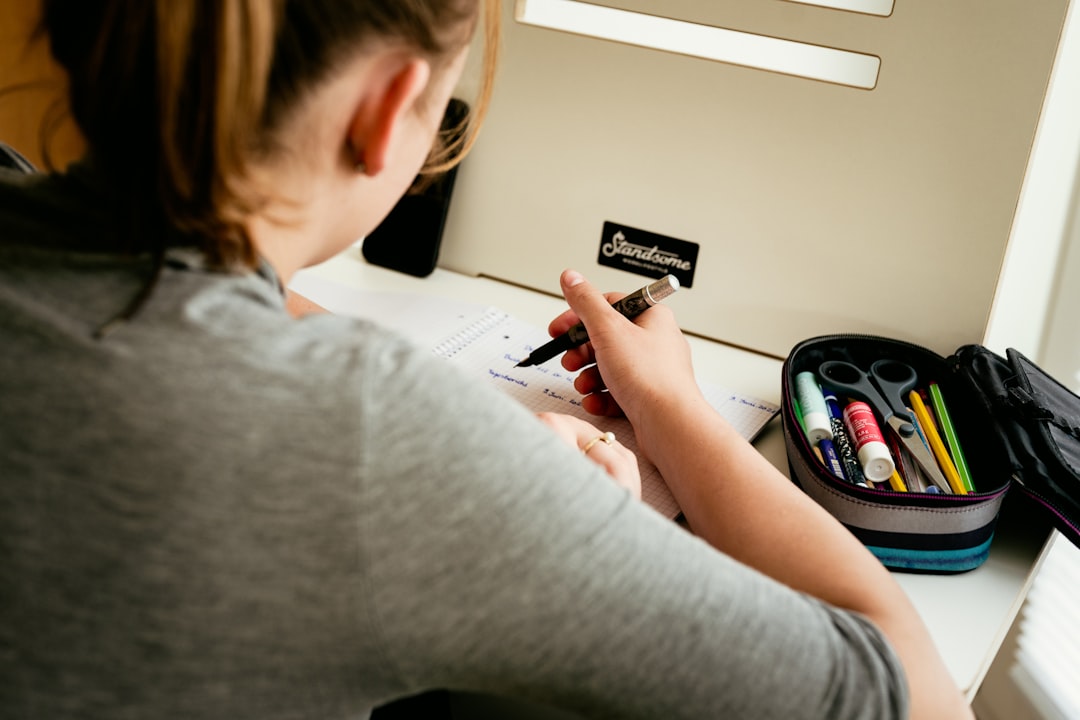
What actually happened, almost every single afternoon for the rest of that year, was homework at the kitchen table. Sometimes the floor. Once, memorably, on the stairs, which I only allowed because she seemed to be getting through a worksheet faster sitting on a step than she ever had at that gorgeous desk.
It took me longer than I would like to admit to understand why. The desk was in a corner, facing a wall, tucked away like a place for quiet, solitary focus. But my kid at eight years old did not want quiet solitary focus. She wanted to be near people. She wanted to hear the dishwasher running and the dog’s nails on the floor and me chopping vegetables a few feet away. The homework spot she actually used was not a spot at all. It was proximity to the rest of the house.
What I stopped trying to force
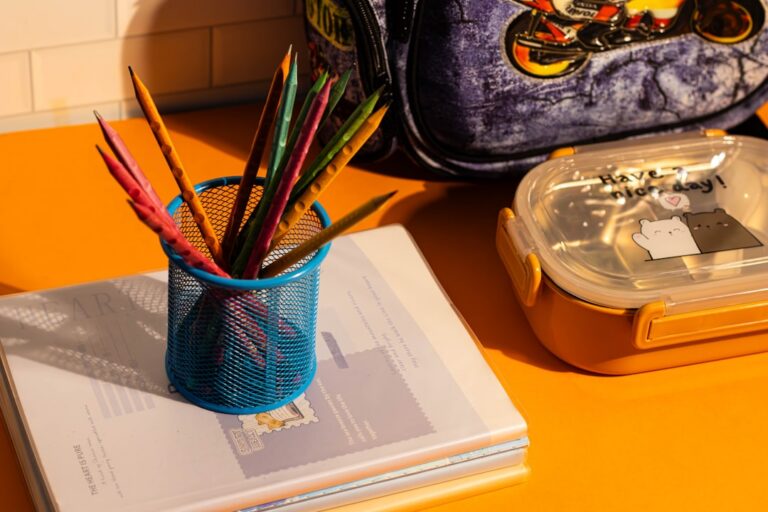
Once I gave up on the desk as the destination, things got easier. I moved the pencil cup and the folder of blank paper to a kitchen drawer instead. I kept a small caddy, the kind with a handle, stocked with pencils, an eraser, a ruler, and a pack of colored pencils, so that wherever she landed, the caddy could land with her. The caddy did more work than any piece of furniture ever did.
I also stopped insisting on total silence. I used to shush the television, shush her brother, shush myself, as if any sound in the house was an act of sabotage against long division. Some kids need dead silence. Mine does not. She needs low background noise and the general hum of a household still functioning around her. Once I let that be true instead of fighting it, homework stopped being a nightly negotiation.
The folder system that finally stuck
The other piece that mattered more than the desk was the folder. Every school sends home some version of a take home folder, usually with a pocket for stuff that goes back to school and a pocket for stuff that stays home. For an entire year I ignored the distinction and just shoved everything into whichever side was open, which meant permission slips missed their deadlines and graded tests disappeared into the void of the backpack.
What fixed it was ridiculously simple. I put a small tray on the kitchen counter, right by where the backpack gets dropped every day, and I made a rule that anything from school goes in the tray before it goes anywhere else. Every evening, while dinner was happening, I would flip through the tray. Sign this, keep that, throw that away, put this back in the folder for tomorrow. It took about ninety seconds a night and it meant nothing sat in the bottom of a backpack for three weeks turning into a soft gray brick of forgotten paper.
The system that works is the one that matches how your kid actually moves through the house, not the one that looks nicest in the corner of a room.
Backpack unpacking, the boring but necessary part
We also settled into unpacking the backpack the moment we walked in the door, before shoes came off, before anything else. It sounds like a small thing but it changed everything about the rest of the evening. Lunch container goes straight to the sink. Folder goes straight to the tray. Backpack gets hung on the hook by the door, empty, ready for tomorrow. If we skip this step, even once, the backpack becomes a black hole and I am digging through it at seven the next morning looking for a field trip form that was due yesterday.
Time management, or my version of it
I do not have a fancy system for the after school stretch. What I have is a rough order of operations that we both know without me having to announce it every day: snack, twenty minutes of just being a kid, then homework, then whatever is left of the evening is ours. The twenty minutes of nothing turned out to be the most important part. She comes home genuinely tired from being a person in a classroom all day, and asking her to sit down and produce more thinking the second she walks in the door was setting both of us up to fight.
A timer helps too, not as a punishment but as a shape for the task. Twenty minutes on the clock feels finite in a way that an open ended stretch of homework does not. She can see the end coming, which makes the middle bearable.
Parent teacher conferences and the mild chaos they bring
Nobody warned me how much scrambling comes with a single fifteen minute parent teacher conference. There is the note that comes home about scheduling, the sign up sheet that closes faster than you expect, the second note reminding you that you have not signed up yet, and then the actual morning of, when I am trying to remember which questions I meant to ask and whether I am supposed to bring anything.
What has helped is keeping a running list, right on the fridge, of things I notice during the year that I want to ask a teacher about eventually. Not urgent enough to email over, but worth remembering. By the time conferences roll around, I already have three or four real questions instead of standing there blanking and asking something generic like how is she doing, which never gets me anything useful.
None of it is dramatic
I say all this knowing it is not a groundbreaking system. There is no app, no color coded chart, no beautiful desk doing the work. It is a tray, a caddy, an unpacking habit, and a willingness to let homework happen on the kitchen floor if that is where my kid actually wants to be. The house adjusted to the kid instead of the other way around, and that is the whole trick, if you can even call it a trick.